#MeWriting Efficiency is the overriding goal for humans producing content today. AI is the perfect tool to drive it:
1. You, a human, provide an input to the AI.
2. The AI generates an output.
3. You paste that output into place.
4. You are efficient.
Notice that you, a human, are not only in the loop. You are in control of the loop. But most importantly, you are efficient, because you let the AI do the bulk of the work. Presumably, Step 2 will become less expensive and take even less time in the future, as hardware, AI, and task strategies improve.
AI developers can make you even more efficient by automating Step 1 and Step 3. You’re still in control though. Nobody who doesn’t embrace AI can match your productivity divided by time spent, a.k.a. efficiency. You have quickly mastered the efficiency side of the coin.
Wait, there is another side? Yes. The content your efficient process produces will be used by someone. That use is the Effectiveness Side of the coin.
To get your content considered on the Effectiveness Side, it has to grab someone’s attention. And then, to get it used as you intended, it has to be interesting. Notice what you are not optimizing for these on the Efficiency Side.
Effectiveness is currently a second-class citizen to efficiency for many people and within many organizations, especially those that are all-in on AI. Effectiveness is often hard to measure, with clicks and likes being crude but available proxies. Courage to prioritize effectiveness is hard to measure, as well.
To get actionable telemetry on the Effectiveness Side, you need to speak to your intended readers (or viewers). You need to ask them if they looked at your content and how closely they played attention. You need to listen for signs that they were or were not engaged with it, regardless of the word content of their answers. You need to accept a qualitative measure of the Effectiveness Side, because any numerical measurement will lie to you. How do you measure what’s inside your readers’ heads?
My recommendation to you is to prioritize effectiveness. Once you have found a good measure of effectiveness and your content meets or exceeds your goals, you can work on being efficient. Nobody cares how efficiently your content is produced if they don’t know about it to begin with.
People tend to be surprisingly effective content creators. AI and automation tend to be surprisingly ineffective. If you are relying on AI to be effective or more effective, the AI should pass two tests: (1) It should actually be effective, and (2) it should not rely on magic to be effective. You should be able to explain, from first principles of how AI actually works, how application of AI to creation of your content will be effective.
I’m tagging this with a new tag, “Branch Elbonian”, as a tribute to Scott Adams’ lifetime work on persuasion. I’ll explain the tag another day when I have more examples to draw from.
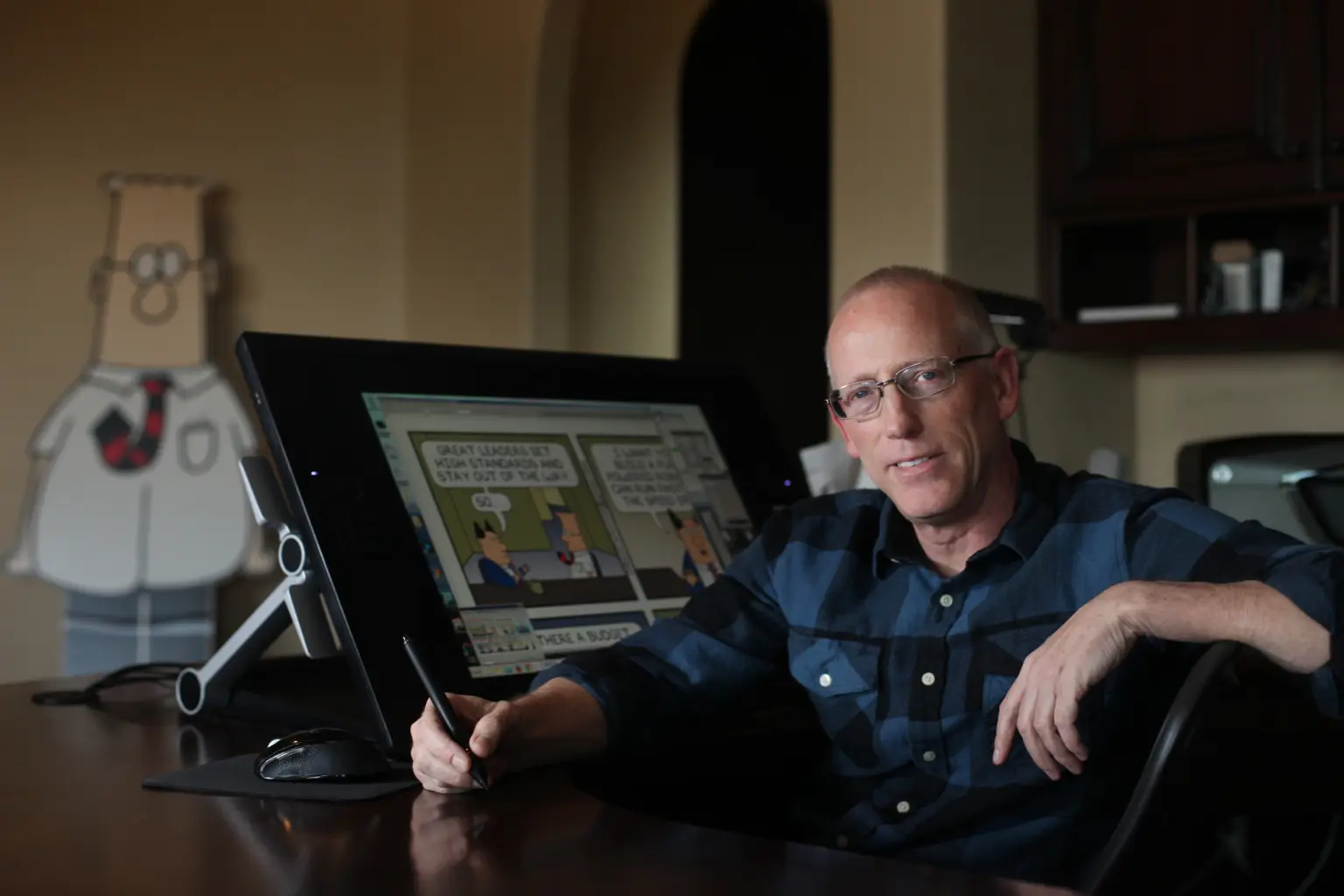
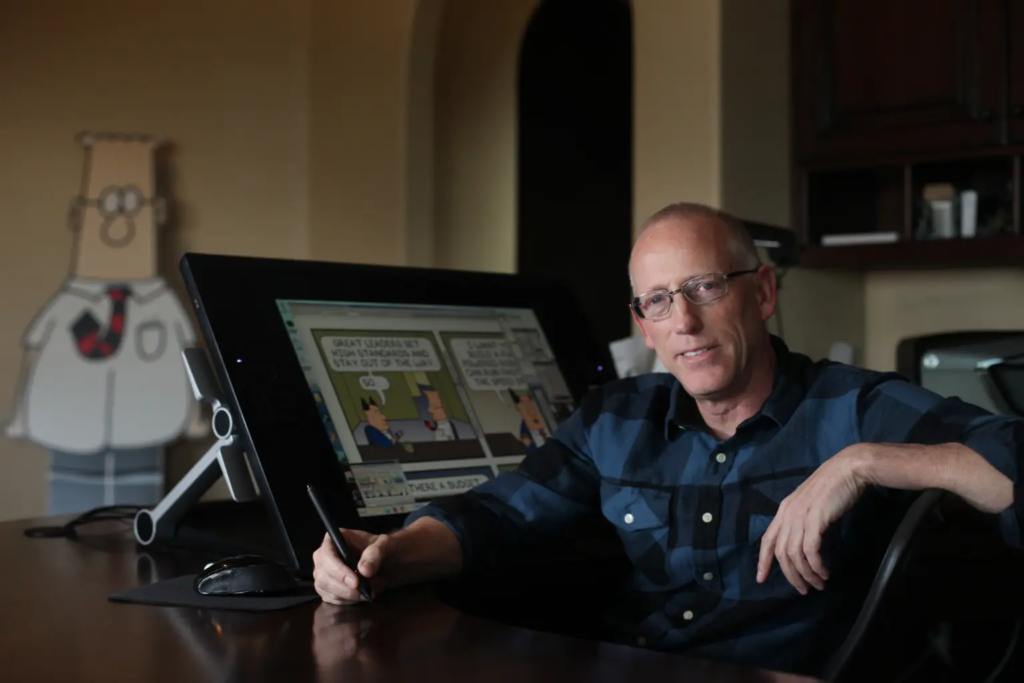
#MeWriting Dilbert cartoonist Scott Adams passed away this morning at the age of 68. Reading the New York Post obituary by his biographer, Joel Pollak, I learned something important about “AI”.
I first encountered Scott in the summer of 1993. I had completed my first year of grad school studying theoretical computer science at UC Irvine, and somehow convinced my Dad and his bosses at Pacific Bell that they should hire me to create a sales tool for T1 lines and Advanced Digital Network (ADN) inspired by graph modeling. I worked in my Dad’s private office at the Bishop Ranch office park and had a work Mac IIfx and my personal PowerBook 170 at my disposal. Yeah, I could program in C++ all day long, but developed the tool in HyperCard. I got paid really well for this work, and it made a huge impact on a sales team.
My Dad and I were walking across the parking lot one afternoon, and I noticed a light blue or silver Datsun Z with the license plate DOGBERT. I asked my Dad if he knew what that was about, and he told me there was this up-and-coming cartoonist who worked in the next pod over. I became a regular daily reader that night. It was amazing to me that Scott/Dilbert was possible, if not tolerated. But it was also amazing to me that I could have everyone I worked with in stitches with a meeting / “meating” joke, as crude as the joke was. There was just something very wrong with office culture. Scott was the reporter on scene who made a career of getting away with it. BTW, I know exactly who visually inspired the Pointy Haired Boss. Absolute dead ringer for the guy. Not my Dad, LOL. I’ll take that knowledge to the grave though.
Despite working in close enough proximity, I never actually met Scott. It didn’t dawn on me that that would be a better thing to do, than say, grabbing coffee with one of the sales guys who was using my tools before they were ready and telling stories to each other. No real work ever got done after lunch. Sorry, not sorry.
Fast forward to 1996, when Scott released his first book, The Dilbert Principle. It was finally okay to say what had been the quiet part out loud. Big business culture had been captured by bullshit. I’d been witness to the progression watching the crap my Dad endured during the 1980s. Let’s revisit “Quality” and “Leadership Development” of that era sometime. Not now.
At the same time people were discovering that big business was big bullshit, the Internet and entrepreneurship made it possible for a whole generation of smart kids to avoid it. Even the dot-com era startups avoided that bullshit. There was, for almost 15 years, a window of effectiveness working for or with small firms. And Dilbert was, for people at these firms, a popular reminder of how good they had it.
In 2015, Scott was the first prominent person to point out how good Donald Trump was at persuasion. Like Trump or not, he was, at that point, quite entertaining and hilarious, mostly for how the “serious people” reacted to him and how he did not care. But Scott connected the dots to persuasion and invoked Cialdini to make the case. It was quite a deep pull at the time. Here’s what I’ll say about Cialdini and persuasion… His groundbreaking book, Influence: Science and Practice, was assigned reading in an “Honors” political science breadth course I took as a Computer Science major as UC Irvine. In my discussion section for the course, comprised mostly of artists, poets, and poly sci types, I was the only one who actually read the book and the only one fascinated by it. In 1991, I knew it was special. I’ve recommended it to every person I’ve worked closely with in my career. Turns out…
Popularizing persuasion as both explanative and practical will be Scott’s most important achievement. It eclipses the Dilbert cartoon. It probably even eclipses his mantra of being helpful. I think Scott appealed to helpful people. I don’t think he changed anyone’s mind or behavior on being helpful. That seems hardwired (or not) to me, with most of the error toward sycophancy rather than opposition.
For 32-1/2 years of my adult life, I’ve been at least a weekly consumer and often a daily consumer of the content Scott produced. It’s much like most of my time, I’ve been a consumer of coffee. It’s not an obsession. It’s not drop everything. It’s more comfortable routine that never disappoints. I don’t always know what I’m going to get, but I know that sometimes, it’s going to be really damned interesting!
The past three years, coincident with both his “cancellation” and the popularization of LLM chatbots, Scott has more than dabbled with chatbottery. He has wanted it to work and to be intelligent, and has been routinely disappointed. I’ve replied to too many of his posts — in the spirit of being helpful — but never broke through the noise. There is a line in Joel Pollak’s obituary this morning that made it all make sense to me:
Adams used what he called the “persuasion filter”: Rather than judging whether political rhetoric was true or false, he simply evaluated it based on whether it was persuasive.
I’ve listened to hours of Scott talking about LLMs, and he never stated explicitly that he was using the same filter for them as for politicians like Trump. He would acknowledge that they gave very confident sounding answers. Every new tool promised to do something really amazing! Enough so, that he tried many of them, and he tried many use scenarios, like narrating his books in “his” voice, etc. Right up to a couple weeks ago, he was working on a process to be applied after he was gone.
Speaking of his voice… Anyone remember when Scott couldn’t talk for three years, from 2015 to 2018? I had totally forgotten, and I had a much longer period when my voice would cut out randomly. Turns out I was fat, and losing 70+ pounds took care of that for me. Scott had Botox, surgeries, and brain retraining to fix his. Scott was many things, but he was never fat.
Anyway, as I spend the next year or so remembering Scott Adams things that gently nudged my iceberg for three decades, I’ll say here that the one that might end up being the most impactful is the connection I just made between the obituary pull quote and his fascination — despite continual and predictable disappointment — with AI.
Thank you, Scott Adams! You were more than helpful.
#MeWriting People of a certain age learned the most important skill for understanding how large language models (LLMs) actually work back in high school. No, we did not learn about neural networks in auto shop. Side note: I had to endure almost a half hour of one on one “academic counseling” to be allowed to enroll in auto shop back in 1987. Low brow class, thought by a credentialed adult to be a waste of my talent. Let your favorite LLM complete that hilarious story.
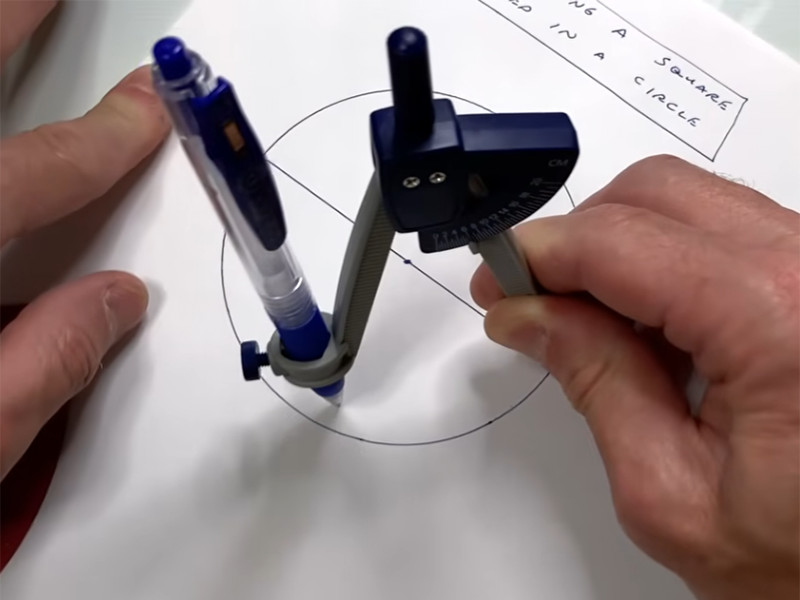
I’m talking about Geometry class. There are two intellectual skills that are generally taught in high school geometry: reasoning and construction. Reasoning is how to prove a hypothesis, one intellectually sound step at a time. In geometry, we called them “proofs”. Construction is taking a limited set of tools and operations and, one intellectually sound step at a time, inventing more complicated operations. In Geometry class, we started with:
A flat piece of paper that can be marked.
A pencil for marking.
A straight edge for marking straight lines.
A compass for drawing arcs of a set radius centered at a point on the paper.
Proof and construction in high school geometry are intellectual exercises — training for our high school brains. In today’s world or the world I entered as an adult, they didn’t have a lot of practical application. My Dad, who was as close as anyone has been to being a professional applied mathematician, never had to trisect an arbitrary angle with only a straight edge and compass. And if he had been required to do that, he would have known that isn’t possible, and I’m confident he could prove it!
I’d like you to take at least 10 minutes to watch some (or better, all) of this video reviewing basic constructions you probably covered in your high school geometry course.
Does any of that seem vaguely familiar to you? The world doesn’t need you to know the specifics to function as an adult. Nor does your job, in all likelihood. But you will be a more effective adult if you know that many of the complicated systems we construct and that you use daily are built from a few very simple principles, with a simple set of rules applied. You should realize that some things can’t be done with some systems of tools and rules. This is an important concept!
It turns out that LLMs are just like this. Here is how every LLM works:
Large set of numerical weights, which define relationships among sets of nearby tokens.
Context window — the ordered set of existing tokens you’re working with.
Way to choose one next best enough random token using the weights and context window as inputs.
The completion algorithm simply runs that operation in the third bullet until it encounters a special “I’m done” token.
Everything else you think you see the LLM doing is just repeated application of these two items and one step. Here is an (old) video of me showing how chat is an illusion:
If you didn’t watch, I showed how chat is just running the completion algorithm until it’s the user’s turn to type something.
If your team has a failed AI project underway, here is how I would lead it to success:
Your team watches the original The Karate Kid (1984) movie.
We will discuss “wax on, wax off”. This is how actual work gets done. More importantly, it’s how we as humans internalize the work that gets done.
We will all watch and replicate the Geometry Constructions video from above. Each team member will perform all 15 constructions using straight-edge and compass. This is a one-day project. We will frame some and decorate the office.
Every use of an LLM in the project will be constructed. We will find some constructions that can’t be done or don’t make sense.
We will focus on the ones that work and make sense, so we can call them wins.
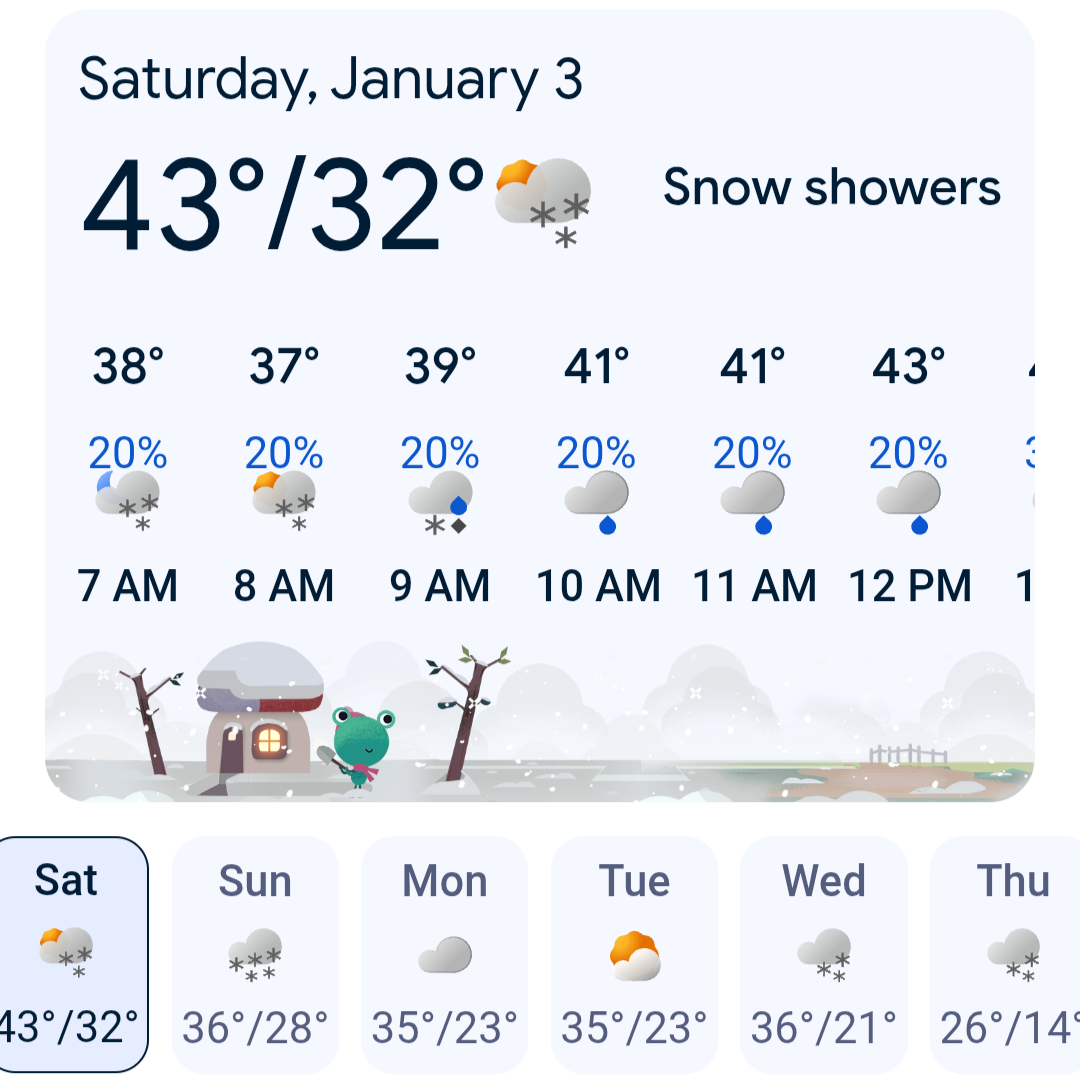
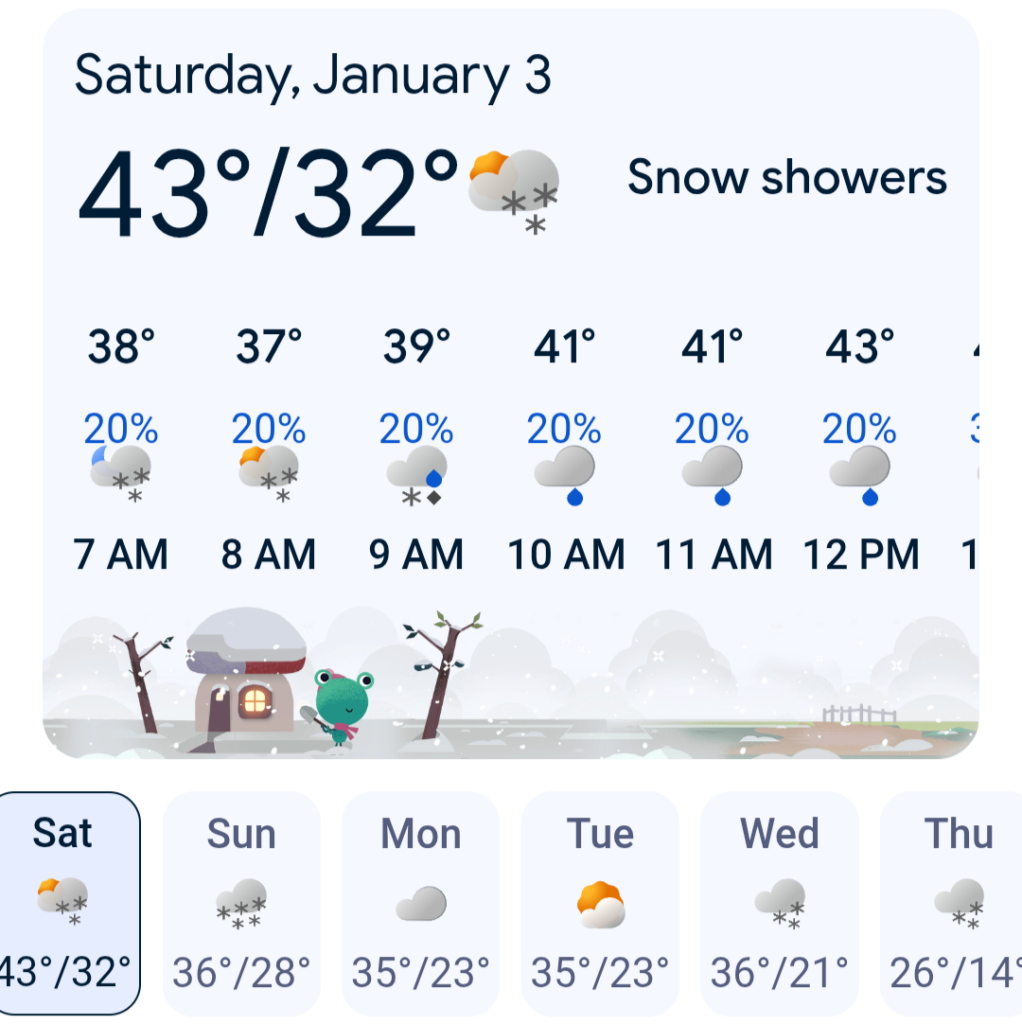
#MeWriting I moved to Minden, NV in mid-September. Minden is east of Lake Tahoe and down the hill at an elevation of about 5000 feet. I didn’t plan this, but circumstances sent me here and different circumstances kept me here. I was a Southern California kid originally and made South Orange County my home for 37 years since coming down from the San Francisco Bay Area for college. You can probably imagine what my horror might be seeing this forecast on my phone today. And you’re at least half right!
The cold is not good to me. I get a touch of Raynaud’s Syndrome when the ambient temperature is below 65℉-ish. For me, it’s blue then white fingers above the knuckles and a search for warm running water to thaw them out. I’m quicker than most with mittens and gloves. I know people who get it much worse, so I don’t need your sympathy. Weight loss has helped out a bunch, but it’s still a day to day concern here more than it was in The (South) OC.
Let me tell you why you’re almost half wrong, though. This is the third time since getting here that I’ve seen 4 days in the next week with a snow forecast. In reality, we got an inch of snow on the ground Christmas morning, and it was gone in a couple hours. Check in with me on Friday, January 9th, and I’m sure I’ll have a similar recap.
My parents live across town. They’ve been here almost 24 years. I already know from visiting through the years that nobody gets the weather predictions right. That’s not what I want fixed here. I really just want it to snow.
The point of this is that there is a weird glitch in the matrix right now. I wonder if and how you have stumbled on it.
#MeWriting In 2026, it will be a good plan to check if your AI idea is messed up. Because in 2023-2025, 95% of them turned out to be. The reason projects fail is because the use of generative algorithms is not consistent with what those algorithms do. I’ve been consistent on that for over 2 years posting here. I’ve lived it and I have felt its pain.
If you need help (pardon me for using this word) “aligning” your business, projects, or ideas with what generative algorithms actually do, please reach out. I can get filthy rich and you can avoid a ridiculously costly mistake. It’s win, win. 95% of your clearly don’t get what these algorithms do, and I think the other 5% are lying, but that’s just a hunch. 🤣
Music credit: me.
I would appreciate your reactions and comments on my LinkedIn post.
#MeWriting One of my favorite YouTube channels is StudPack. It’s an ongoing story of a father, his son, and his son-in-law building a dream house for his son, and doing interesting side projects along the way.
In recent Christmas holiday videos, they’ve been working to fix big problems in a friend’s home. The friend’s family is facing long-term financial challenges. Basic home maintenance and finishing home improvement projects got derailed at some point.
One big task they took on was fixing a support beam in the kitchen ceiling. To do that, they had to frame two temporary 12-ish foot load-bearing walls on both sides of the beam. These took time. These took dimensional lumber. These took planning. These were an important part of the process of fixing the beam. Here is the episode where they document this work:
Why am I fascinated with this? Because “in the trades”, as the kids say, temporary artifacts are necessary to allow big things to take shape. In building the son’s dream house, they are continually erecting and dismantling scaffolding. If you watch carefully, you’ll find esoteric examples of temporary in everything they do.
We rarely build temporary things with non-physical mind work. It is a labor of discipline bordering on stubbornness to get anyone to throw away a draft or a prototype. We see that approach as inefficient. Don’t get me started about removing unused features and interface clutter!
Into our crowded archive of every thought and attempt at thinking come algorithms that can generate new expressions of thoughts and changes to expressions quickly and inexpensively. We’re not at all inclined to value what they produce as temporary, so it necessarily becomes clutter and slop. We don’t have the discipline to under-value or correctly value, so we naturally over-value.
Put another way: We have these new generative AI tools that can generate content that will move our own thinking a few feet. We insist on maximizing the value of everything the tools generate. Instead of things to consider, temporary support to formulate bigger ideas, scaffolding for accessing out of reach places, we treat them as fully formed solutions. In over-valuing them, we get slop.
And another way: Filling a blank page doesn’t have to be permanent. It should be something we come back and replace. We should dedicate the time and attention to do so.