
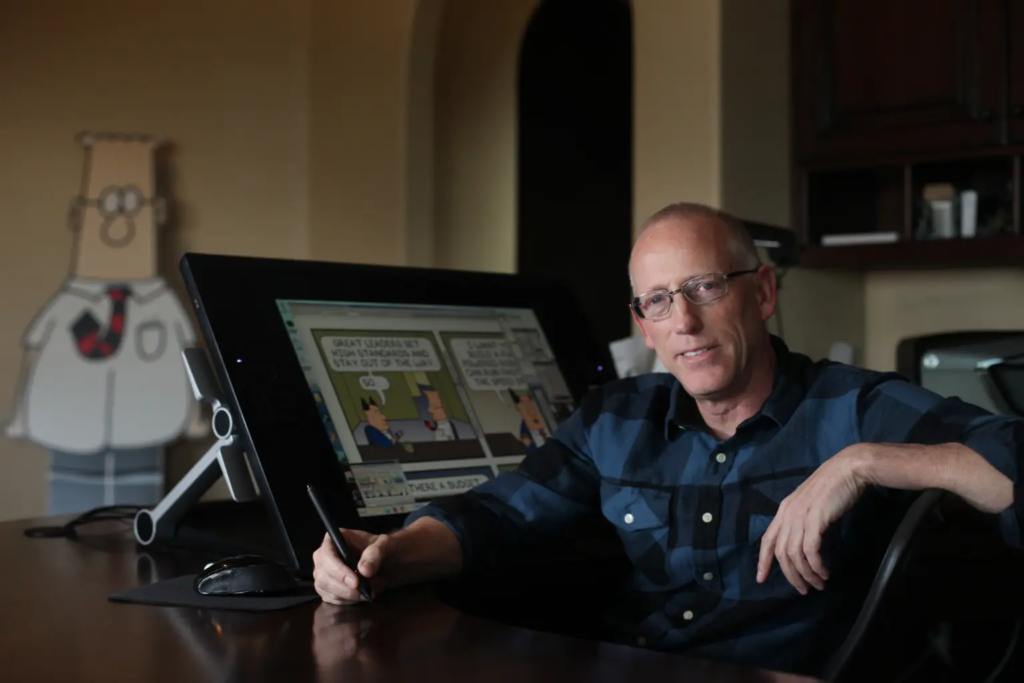
#MeWriting Dilbert cartoonist Scott Adams passed away this morning at the age of 68. Reading the New York Post obituary by his biographer, Joel Pollak, I learned something important about “AI”.
I first encountered Scott in the summer of 1993. I had completed my first year of grad school studying theoretical computer science at UC Irvine, and somehow convinced my Dad and his bosses at Pacific Bell that they should hire me to create a sales tool for T1 lines and Advanced Digital Network (ADN) inspired by graph modeling. I worked in my Dad’s private office at the Bishop Ranch office park and had a work Mac IIfx and my personal PowerBook 170 at my disposal. Yeah, I could program in C++ all day long, but developed the tool in HyperCard. I got paid really well for this work, and it made a huge impact on a sales team.
My Dad and I were walking across the parking lot one afternoon, and I noticed a light blue or silver Datsun Z with the license plate DOGBERT. I asked my Dad if he knew what that was about, and he told me there was this up-and-coming cartoonist who worked in the next pod over. I became a regular daily reader that night. It was amazing to me that Scott/Dilbert was possible, if not tolerated. But it was also amazing to me that I could have everyone I worked with in stitches with a meeting / “meating” joke, as crude as the joke was. There was just something very wrong with office culture. Scott was the reporter on scene who made a career of getting away with it. BTW, I know exactly who visually inspired the Pointy Haired Boss. Absolute dead ringer for the guy. Not my Dad, LOL. I’ll take that knowledge to the grave though.
Despite working in close enough proximity, I never actually met Scott. It didn’t dawn on me that that would be a better thing to do, than say, grabbing coffee with one of the sales guys who was using my tools before they were ready and telling stories to each other. No real work ever got done after lunch. Sorry, not sorry.
Fast forward to 1996, when Scott released his first book, The Dilbert Principle. It was finally okay to say what had been the quiet part out loud. Big business culture had been captured by bullshit. I’d been witness to the progression watching the crap my Dad endured during the 1980s. Let’s revisit “Quality” and “Leadership Development” of that era sometime. Not now.
At the same time people were discovering that big business was big bullshit, the Internet and entrepreneurship made it possible for a whole generation of smart kids to avoid it. Even the dot-com era startups avoided that bullshit. There was, for almost 15 years, a window of effectiveness working for or with small firms. And Dilbert was, for people at these firms, a popular reminder of how good they had it.
While Scott continued to draw the Dilbert strip, he had pivoted to religion, philosophy, life advice, persuasion, and even politics as his book themes: God’s Debris, The Religion War, Stick to Drawing Comics, Monkey Brain!
In 2015, Scott was the first prominent person to point out how good Donald Trump was at persuasion. Like Trump or not, he was, at that point, quite entertaining and hilarious, mostly for how the “serious people” reacted to him and how he did not care. But Scott connected the dots to persuasion and invoked Cialdini to make the case. It was quite a deep pull at the time. Here’s what I’ll say about Cialdini and persuasion… His groundbreaking book, Influence: Science and Practice, was assigned reading in an “Honors” political science breadth course I took as a Computer Science major as UC Irvine. In my discussion section for the course, comprised mostly of artists, poets, and poly sci types, I was the only one who actually read the book and the only one fascinated by it. In 1991, I knew it was special. I’ve recommended it to every person I’ve worked closely with in my career. Turns out…
Popularizing persuasion as both explanative and practical will be Scott’s most important achievement. It eclipses the Dilbert cartoon. It probably even eclipses his mantra of being helpful. I think Scott appealed to helpful people. I don’t think he changed anyone’s mind or behavior on being helpful. That seems hardwired (or not) to me, with most of the error toward sycophancy rather than opposition.
For 32-1/2 years of my adult life, I’ve been at least a weekly consumer and often a daily consumer of the content Scott produced. It’s much like most of my time, I’ve been a consumer of coffee. It’s not an obsession. It’s not drop everything. It’s more comfortable routine that never disappoints. I don’t always know what I’m going to get, but I know that sometimes, it’s going to be really damned interesting!
The past three years, coincident with both his “cancellation” and the popularization of LLM chatbots, Scott has more than dabbled with chatbottery. He has wanted it to work and to be intelligent, and has been routinely disappointed. I’ve replied to too many of his posts — in the spirit of being helpful — but never broke through the noise. There is a line in Joel Pollak’s obituary this morning that made it all make sense to me:
Adams used what he called the “persuasion filter”: Rather than judging whether political rhetoric was true or false, he simply evaluated it based on whether it was persuasive.
I’ve listened to hours of Scott talking about LLMs, and he never stated explicitly that he was using the same filter for them as for politicians like Trump. He would acknowledge that they gave very confident sounding answers. Every new tool promised to do something really amazing! Enough so, that he tried many of them, and he tried many use scenarios, like narrating his books in “his” voice, etc. Right up to a couple weeks ago, he was working on a process to be applied after he was gone.
Speaking of his voice… Anyone remember when Scott couldn’t talk for three years, from 2015 to 2018? I had totally forgotten, and I had a much longer period when my voice would cut out randomly. Turns out I was fat, and losing 70+ pounds took care of that for me. Scott had Botox, surgeries, and brain retraining to fix his. Scott was many things, but he was never fat.
Anyway, as I spend the next year or so remembering Scott Adams things that gently nudged my iceberg for three decades, I’ll say here that the one that might end up being the most impactful is the connection I just made between the obituary pull quote and his fascination — despite continual and predictable disappointment — with AI.
Thank you, Scott Adams! You were more than helpful.
I would appreciate your reactions and comments on my LinkedIn repost.